
Nothing Is Wrong With You
Nothing is random. It just feels that way.
Why Did You Do That? It's Not Random
The hesitation. The override. The pullback. The return.
You've Done This.
You don't do things randomly.
You repeat patterns.
Patterns far more consistant than you realise.

It's not random. It just feels that way.
"I realised there was never anything wrong with me.
For the first time in my life, I felt genuinely relieved and free from the past" -Sherre Foster USA
"I spent years chasing achievements, thinking they’d make me feel something.
This showed me my emotions were being shaped all along — and that changed everything." - Emmy Rivers. UK
"This completely changed how I see myself.
Understanding that I’m not my beliefs — and that I can rebuild them — was powerful." - Ava Volante UK
"It dissolves the layers of self doubt with such tenderness and truth. It lovingly invites you to see yourself through softer, more compassionate eyes." - Lynda Egiz UK
Most people already know what they 'should' do.
They know how to improve their health, their finances, their relationships, or their confidence — yet the same patterns keep repeating.
This isn’t a lack of information or motivation.
Behaviour doesn’t change at the level of advice or intention. It changes at the level of belief — specifically, the beliefs that feel emotionally true in the moment action is required.
That’s why you can want to act differently and still default to the same responses. The belief driving the behaviour was never updated — only temporarily overridden.
Most change methods work downstream: habits, thinking, discipline. When beliefs remain intact, effort becomes exhausting and progress unstable.
Being “stuck” isn’t a personal flaw.
It’s what happens when the mechanics driving behaviour remain unseen.
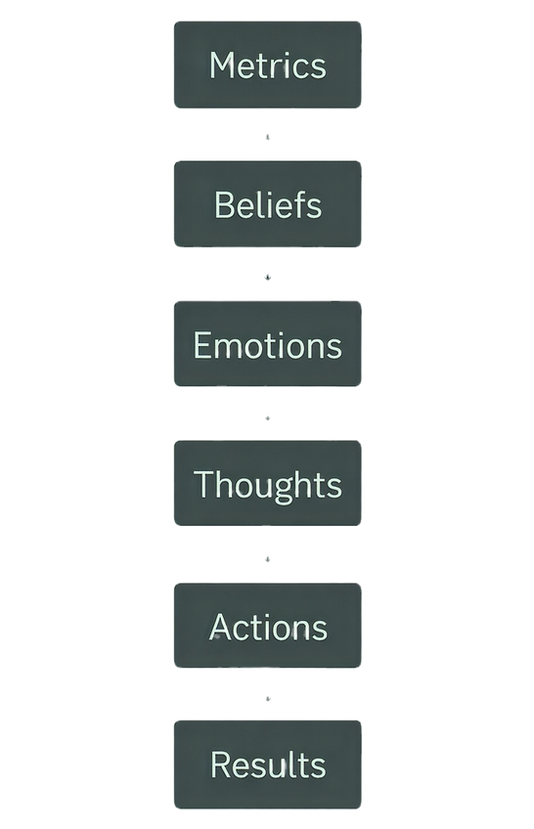
How Behaviour Actually Works
Behaviour is not random, and it isn’t driven by willpower.
Every action you take — and every action you avoid — follows a consistent internal sequence. When that sequence is understood, behaviour becomes predictable rather than mysterious.
At the root of every result is a metric — the internal logic used to decide what something means. That metric forms a belief, which generates emotion, shapes thoughts, determines actions, and produces results.
This sequence is always running.
MBETAR is simply the name given to that process:
Metrics → Beliefs → Emotions → Thoughts → Actions → Results
Most approaches to change work downstream, at the level of thoughts or actions. MBETAR works upstream — by updating the metric that made a belief feel true in the first place.
When the belief changes, action no longer requires force.
MBETAR doesn’t ask you to fight yourself.
It shows you where the behaviour is coming from.
Once the mechanics are clear, the next question is why effort so often fails.

Why Beliefs Don’t Change Through Effort
Beliefs don’t change because you decide they should.
They change when the emotional logic that made them feel true no longer holds.
That’s why effort-based approaches struggle. You can think differently for a while, behave differently for a while, even feel different temporarily — but if the belief underneath remains intact, the system eventually resets.
Real change happens when the metric changes — when the internal rule used to judge meaning no longer makes sense.
When that happens, belief updates automatically. Emotion follows. And behaviour reorganises without force.
This is the difference between managing yourself and understanding yourself.
MBETAR is not a method for trying harder.
It’s a way of seeing clearly enough that effort becomes unnecessary.
Where This Framework Came From
This framework didn’t come from theory or academia.
It came from repeatedly observing the same internal patterns across real decisions, real consequences, and real results — first in my own life, and then in others’.
I grew up in South Wales, left school with no formal academic path, and built a high-profit service business by paying close attention to what actually drove behaviour — not what people said should.
Over time, one sequence kept revealing itself beneath every outcome. Once that sequence was clear, it became impossible to ignore.
MBETAR is simply the result of staying with that observation long enough to understand it.


Why This Became a Book
Frameworks like this don’t fit into posts, talks, or soundbites.
Once the mechanics behind belief and behaviour are understood, they raise questions that can’t be answered briefly — about responsibility, self-worth, emotion, freedom, and what change actually requires.
The book exists to work through those questions properly.
Not to persuade, motivate, or simplify — but to document MBETAR in full, address its implications, and remove the common misunderstandings that arise when belief change is reduced to techniques.
The website introduces the framework.
The book is where it’s examined properly.


Sherre Foster USA
Most impactful for me was the epiphany that there really wasn't anything wrong with me! I felt unburdened for the first time in my adult life. If you, or your loved ones, are still chained to the past, please arm yourself with this tool. Read it, then read it over again. I truly believe that it will help you move forward in your life.
How This Book Impacts People
Ava Volante UK
This book changed the way I see myself.
MBETAR explains why we feel what we feel and how the beliefs we formed in early in life shape our emotions, thoughts, and results. Realising that I am not my beliefs, and that they can be rebuilt was so empowering.
Nothing Is Wrong With You doesn't tell you to think differently. It shows you how. Beautifully written, authentic and thoroughly engaging. Finally someone who understands me!
You don’t need to force change. You need understanding
Emmy Rivers UK
I can honestly say the understanding in this book has changed my life.
For years I forced action, pushing myself to achieve - But when I had my big win, I found myself asking... “Is this it? What now?” All I ever truly wanted was to feel deeply, genuinely happy. In this book, Jay Marshall provides the tools to create that kind of life. It helped me realise happiness wasn’t in the next achievement - it was in understanding how my beliefs were shaping my emotions.
What This Site Is For
This site exists to document MBETAR — the framework, its implications, and the thinking that follows from it.
There’s no programme to join and nothing to adopt on faith. Just writing, diagrams, and ongoing work exploring how beliefs actually shape human behaviour.
If you want to read, reflect, or examine the framework properly, you’re welcome to stay.